
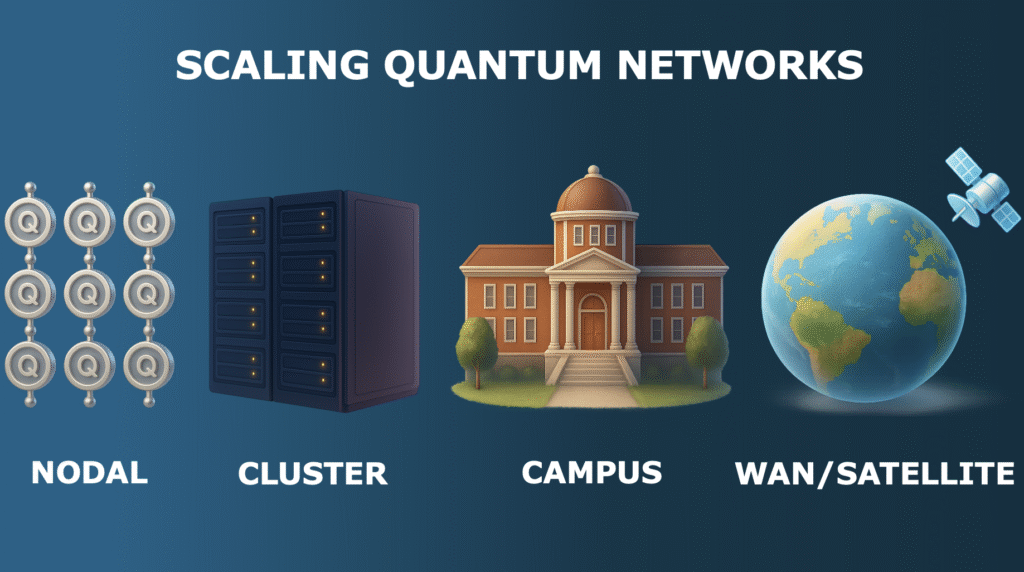
Classical computing networks evolved from monolithic ‘walled gardens’ performing very specific functions to flexible, multi‑layered infrastructures capable of supporting an array of workloads across billions of users. In order to achieve broad commercial adoption and fulfill the promise of harnessing quantum physics, quantum systems must grow past today’s self-contained entanglement schema if they are to achieve quantum advantage across a range of workloads and solutions. These powerful systems will need to be able to network on demand with other quantum systems in a manner that preserves the quantum state (i.e. entanglement) allowing qubit power to be delivered as/when needed in a way that’s secure, scalable, and modular. This approach enables not only scale which exceeds the then-current maximum qubit count of a given system, but modular growth-on-demand, cooperative computing, and new distributed sensing capabilities. However, the ‘quantum internet’ isn’t likely to be the first article of quantum networking. Industry insiders predict the emergence of a four‑tier quantum networking model as a roadmap for this evolution, spanning nodal, then cluster, campus, and finally WAN/satellite network configurations over time as technology continues to mature. With this evolution, quantum communications is likely to achieve the $11-15B market size defined by McKinsey & Company in their recent Quantum Technology Monitor (published last week).
This article touches on the staged evolution of quantum networking, and key developments and workloads at each stage.
At the nodal tier qubits are entangled across/between QPUs to extend the usable qubit count of a quantum computer within a single image, likely within a single cryostat or vacuum chamber. This level of networking is essential: it’s connecting tens to hundreds (eventually millions) of qubits into one cohesive system. This can be done by physically moving the qubits around over short distances, or through optical and electrical signals on a chip to establish entanglement through gate operations.
Companies across numerous modalities (trapped ions, neutral atoms, superconducting, silicon spin and photonics) have demonstrated coherence times ranging from a few hundred microseconds up to several seconds, and multi‑qubit gate or entanglement fidelities consistently in the high‑99‑percent range. For example, photonic platforms like PsiQuantum’s Omega chipset report inter‑chip interconnect fidelities above 99.7 percent and buffer‑times on the order of milliseconds.
These achievements show that regardless of technology, the industry has the reliable “wiring” needed to build self‑contained quantum modules. And while today’s commercial systems are largely single-module, research labs and other startups have shown that you can chain these modules edge-to-edge over centimeter distances to begin assembling larger, multi-module processors.
At the cluster tier, the challenge becomes to enable pooling of multiple nodal modules across benches or racks, essentially creating the first “quantum data centers.” This is where localized networks share entanglement resources, run distributed gate operations, and deliver error‑correction capabilities across several nodes. The implications of this set of capabilities are significant in a number of ways. From a scaling perspective, this allows the qubit counts of multiple quantum systems to be applied to difficult algorithms, problems, and workloads that exceed the capabilities of a single system. From a deployment perspective, it allows organizations to employ a modular, flexible path: to start their quantum journey small (development, training, prototyping, etc.) and add systems as the workloads grow. Both of these vectors accelerate market adoption.
Quantum computing companies working on superconducting, photonic, trapped‑ion and neutral‑atom platforms have shown the viability of transporting quantum states over nodal (1–2m) fiber or free‑space ranges with proprietary approaches. Quantum networking startups such as Lightsynq (acquired by IonQ), memQ, NuQuantum, Qunnect, and Welinq are developing rack‑scale and larger intermediary interconnect modules that are modality agnostic. Their goal is to make standardized quantum network units that can be deployed in commercial quantum data centers, enabling predictable, high‑throughput entanglement distribution as needed, between both systems and compute vendors.
These cluster setups will likely operate in hybrid environments, with classical servers managing job scheduling, error mitigation, and user interfaces while the quantum systems attack the extremely large problems.
At the campus tier, the focus shifts from individual racks to connecting entire facilities, linking floors or buildings to create shared quantum resources across a given site. Use cases include campus‑wide quantum key distribution (QKD), remote access to centralized quantum data centers for algorithm benchmarking, cooperative processing for multi-phase workloads, and distributed sensing experiments. At this scale, the need for quantum memories (likely based on cold-atoms or rare earth ions) becomes much more acute due to noise and latency; entanglement operations will require an asynchronous staging area for qubits being paired and entangled under precise timing control.
A leading example is the Chicago Quantum Network, operated by the University of Chicago’s Pritzker School of Molecular Engineering in partnership with Argonne National Laboratory and industry partner Toshiba. This metropolitan testbed links six nodes across the city and suburbs, with Toshiba demonstrating QKD at 80,000 quantum bits per second and memQ achieving sub-nanosecond clock synchronization over 132 km using entangled photon pairs. The network supports multiple research teams and lays the groundwork for campus‑wide quantum services and future repeater trials.
The ultimate vision is a global quantum backbone spanning continents via long‑haul fiber and satellites. Use cases range from intercity QKD and global clock synchronization to distributed climate sensing, though most of these remain experimental with the exception of QKD, which is already seeing limited deployment.
China’s Micius satellite has already distributed entangled photons over 1,203 km. Meanwhile, first‑generation quantum repeaters using rare‑earth memories and cold‑atom modules are in development and promise to extend entanglement over long distances. For example, QuTech heads the Quantum Internet Alliance, a 40‑partner €24 million initiative funded by the European Commission that aims to prototype a large‑scale quantum network with repeater stations spanning hundreds of kilometers.
At memQ we are building the backbone for both short and long distance quantum networking. Our extensible quantum networking architecture (xQNA) includes the required components and technologies for all of the above tiers. Quantum network interface controllers enable entanglement actions to be taken on source matter qubits to spin off photons which can be transduced to transit optical networks. Quantum memories equipped with rare-earth ions doped on commercial foundry platforms provide the intermediary staging area for distributed entanglement operations. Quantum control systems are embedded in silicon photonic integrated circuits supporting wavelength and encoding methods that are fully compatible with the existing and ubiquitous C-band telecom infrastructure. The result is an orchestrated approach designed to generate, store, and distribute entanglement asynchronously across all tiers of quantum networking. This technology can be used to enable QPU-to-QPU scaling, chain modules in a rack, share entanglement across a campus, or prepare for long‑haul repeater deployments, positioning us at the heart of scaling quantum networks.
That said, scaling quantum networks remains extremely challenging. Achieving high‑fidelity qubit operations on a single device is only the first step. Realizing the 4-tier vision will require collaboration among startups, national labs and established companies, just as classical networks evolved through joint efforts across research, industry and government. Through continued innovation today’s testbeds evolve into the robust, large‑scale quantum infrastructure that will usher in a new era of computing.